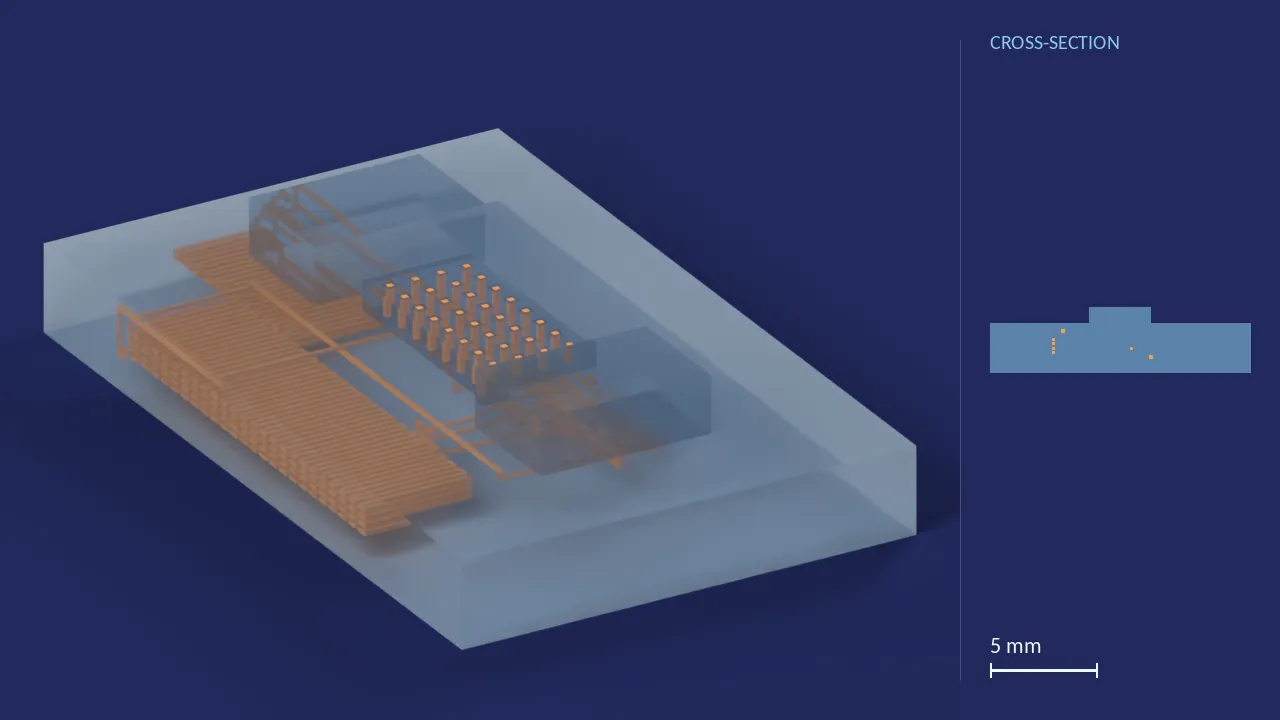
Geometry
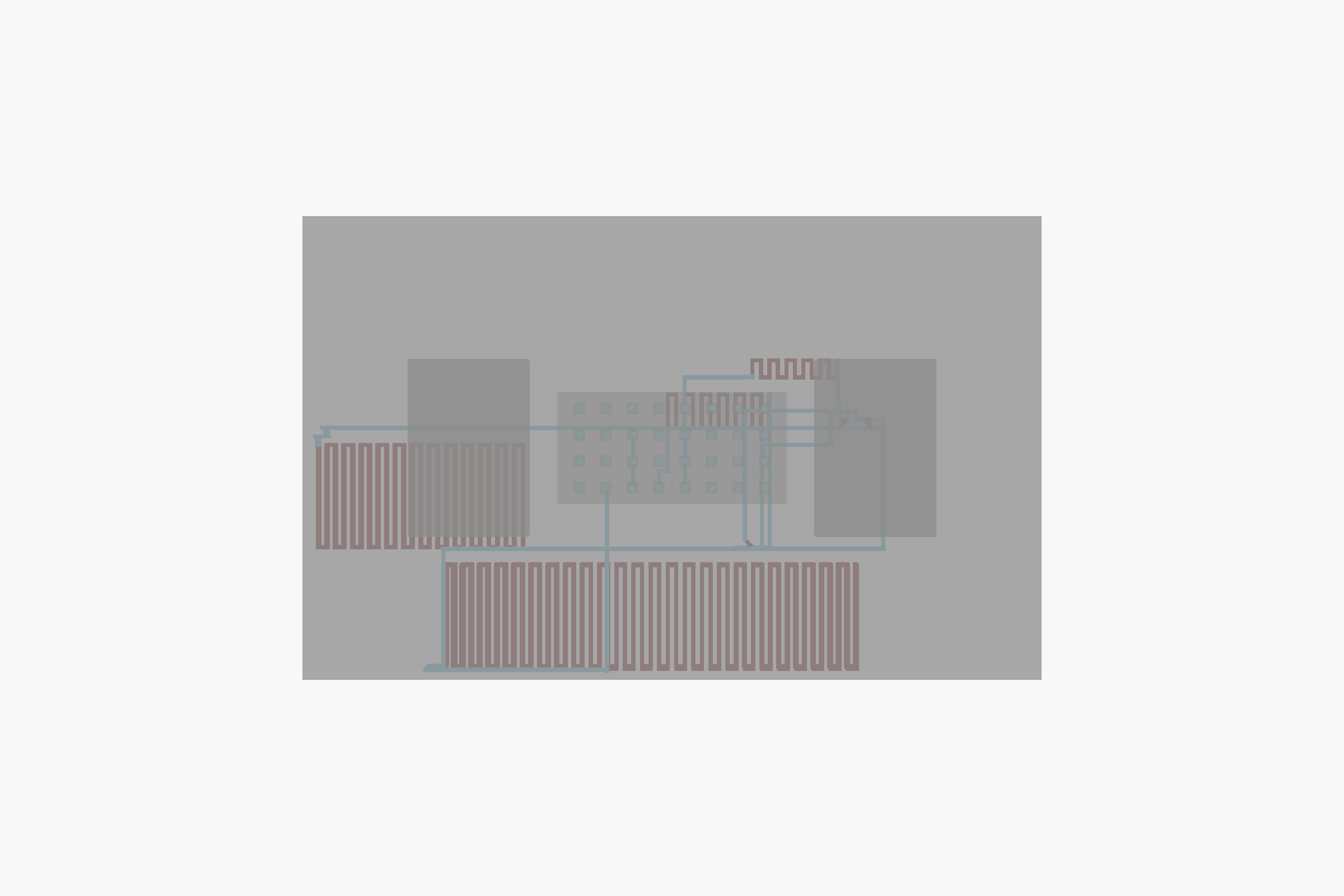
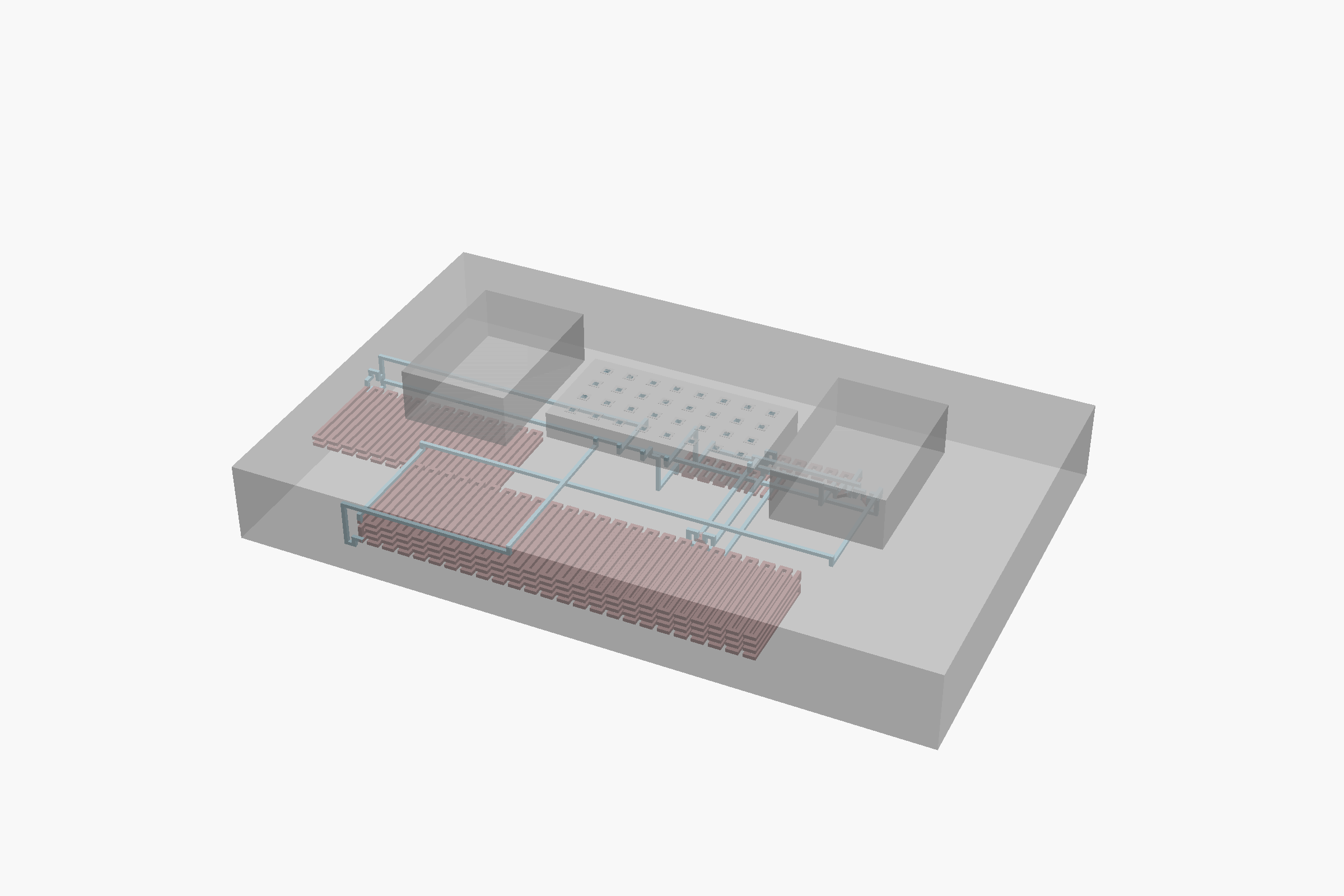
Top view (left) and isometric view (right) of the placed-and-routed chip. Rendered with OpenSCAD from the chip’s SCAD source, salicylic_acid_reroute.scad. Click for high-resolution.
Download: PNG (top) · PNG (iso) · SCAD source ↓
Specifications
Assay
This chip is designed to measure urinary salicylate concentration via the Trinder colorimetric reaction. Acidic ferric nitrate reacts with salicylate to form a violet ferric salicylate complex whose absorbance is measured spectrophotometrically; the absorbance is proportional to the salicylate concentration in the original sample.
Clinically, urinary salicylate quantification supports NSAID monitoring, aspirin overdose detection, and routine follow-up of chronic salicylate users (e.g. patients on long-term low-dose aspirin or arthritis regimens).
The chemistry is adapted from the Beckman Coulter AU480 reagent kit BASOSR7S229 (Salicylic Acid). The chip implements passive resistance-metering to combine the urine sample with three reagent streams at the volumetric ratios required by the Trinder protocol; the output channel collects the mixed product for off-chip spectrophotometric readout.
Simulated outlet concentrations
From the pipeline’s circuit simulation. Nothing here was measured.
This table is output of the pipeline’s circuit simulation (Xyce), written by its evaluation step. For each input it gives the concentration the simulation reaches at the chip’s outlet, out, at time 0.0 in the file, against the concentration the design targets there. No analyzer and no urine sample are involved.
| Input | Time | Node | Error | Target conc. | Simulated conc. |
|---|---|---|---|---|---|
sample | 0.0 | out | 2.90 % | 0.012605 | 0.012239 |
H2O | 0.0 | out | 0.37 % | 0.042017 | 0.042171 |
R2 | 0.0 | out | 2.94 % | 0.315126 | 0.324403 |
R1 | 0.0 | out | 1.44 % | 0.630252 | 0.621187 |
Source: Chem_Eval.csv. Concentrations are fractions of the mixed stream at the outlet (sample + H2O + R1 + R2 sum to 1.0); Error is the simulated concentration’s relative deviation from the design’s target.
Files
- SCAD
salicylic_acid_reroute.scad1.8 MBDownload - LEF
h.r.3.3_salicylic_acid_pcells.lef2.4 KBDownload - CSV
pcell_out_scad266 BDownload - CSV
Chem_Eval.csv309 BDownload - GUIDE
route.guide2.7 KBDownload - PNG
salicylic_acid_iso_large.png123.9 KBDownload - PNG
salicylic_acid_top_large.png19.3 KBDownload
salicylic_acid_reroute.scad is the placed-and-routed 3D geometry — the main OpenSCAD source for this chip. h.r.3.3_salicylic_acid_pcells.lef contains chip-specific cell abstracts. pcell_out_scad lists the parametric serpentine-channel variants this chip required (with L1 / L2 / turn count). Chem_Eval.csv is the pipeline’s simulation of the outlet concentrations, shown above. route.guide is the OpenROAD routing guide produced during PNR. The PNG renders are high-resolution versions of the views shown in the Geometry section above.
Papers
-
Related methodology archetype
Goenner, B., Temple, S., Zapata, S., Wakeham, D., Snelgrove, A., Gaillardon, P.-E., Nordin, G. P., & Gale, B. K. (2025). An open source platform to automate the design, verification, and manufacture of 3D printed microfluidic devices. Scientific Reports, 15, 33077. DOI: 10.1038/s41598-025-15976-9
Applications
For research use only. Not for use in diagnostic procedures.
A design for urinary salicylate quantification by the Trinder method, the kind of assay used for NSAID monitoring and aspirin-overdose detection. The table above is a simulation. One of the urinalysis chip designs in the Gale Lab urinalysis chip family (Erica Francis).